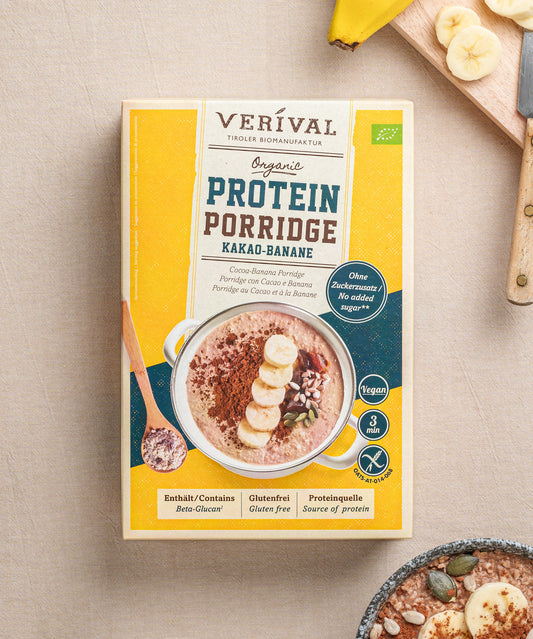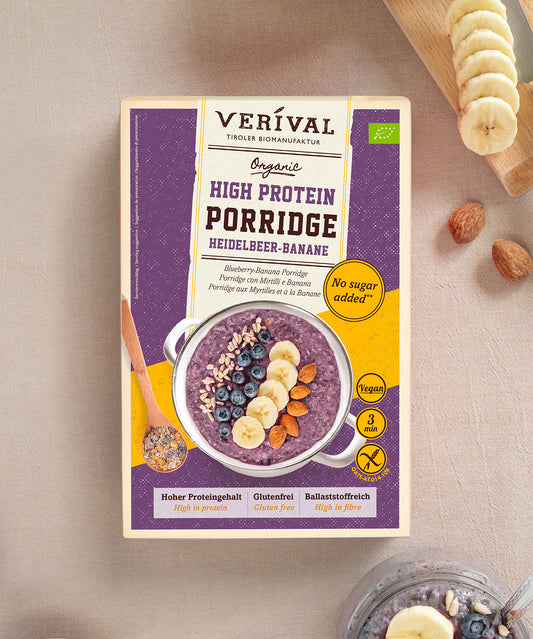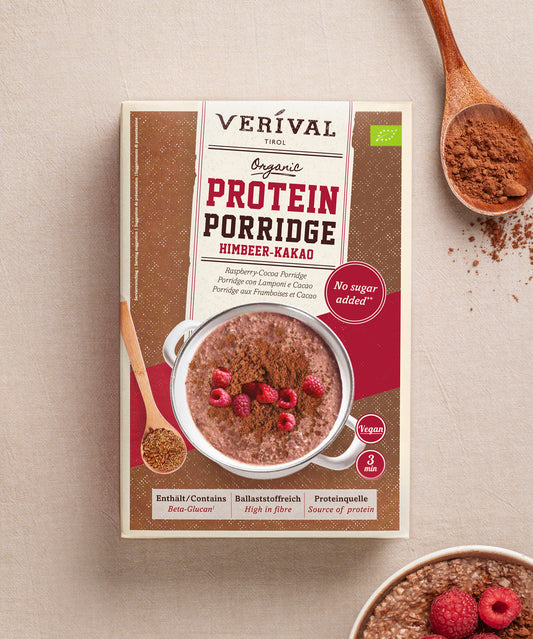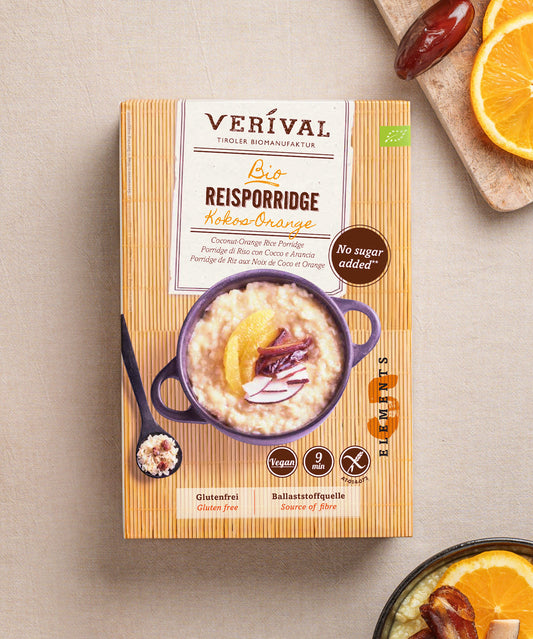

Anyone who wants to keep their blood sugar stable will inevitably come across the term “glycemic index” (GI) when researching the topic. But which foods are actually suitable for a balanced, blood sugar-friendly diet? And does it even make sense to transfer isolated numerical values from tables into everyday life? In this article, we take an in-depth look at food groups that are often associated with a low GI.
Verival low GI breakfast – try it now
Glycemic index and blood sugar levels – how are they related?
The glycemic index describes, under laboratory conditions, how quickly and how strongly a carbohydrate-containing food raises blood sugar levels compared to pure glucose. In theory, a low GI stands for a slower and flatter rise, while a high GI stands for a faster rise.
It is important to avoid scaremongering: the fact that blood sugar rises after a carbohydrate-rich meal is not a danger, but a completely normal and necessary physiological reaction of the body to supply cells with energy. However, a more stable, wave-like curve can help to keep energy levels more constant throughout the day. It is important to view the GI only as a theoretical guide for individual foods. In everyday life, the composition of the entire meal almost always determines the actual blood sugar response.
Foods with a low glycemic index
When nutritionists talk about foods with a low GI, they are usually referring to natural products. However, their actual health value rarely lies in the GI value itself, but in their nutrient density. They usually provide valuable fiber, vitamins, and minerals.
Whole grain products
- Whole grain oat flakes
- Whole grain bread with whole grains
- Brown rice
- Quinoa
Due to their intact natural structure and high fiber content, the body has to work harder to digest them. The grain is broken down more slowly, which means that the carbohydrates are released into the blood more continuously. Porridge made from whole grain flakes therefore provides more stable energy than a highly processed white flour product.
Legumes
- Lentils
- Chickpeas
- Beans
Legumes are true all-rounders in a blood sugar-friendly diet. Although they contain complex carbohydrates, they naturally provide the perfect antidote to rapid blood sugar spikes: plenty of plant protein and fiber that is good for the gut.
Fruit and berries
- Apples
- Pears
- Berries
Most local fruits have a low to medium GI. This is often due to their fructose content, which affects blood sugar differently than glucose, but mainly due to the food matrix. Fiber and a high water content slow down the absorption of natural fruit sugar. An exception is very ripe, soft fruits (such as brown bananas), in which the starch has already been largely converted into simple sugars.
Vegetables
This is where the concept of the glycemic index reaches its scientific limits. Since 50 grams of usable carbohydrates must be consumed to determine the GI, you would have to eat over two kilograms of zucchini at once, for example. The application of the GI to vegetables with a high water content is therefore meaningless in practice. More importantly, vegetables contain extremely few carbohydrates (a very low glycemic load) and are rich in fiber. They are the perfect basis for any meal, completely independent of theoretical GI tables.
Nuts and seeds
Here, too, the classification must be viewed critically. Nuts and seeds consist primarily of fats and proteins and provide hardly any usable carbohydrates. Assigning them a low GI distracts from their actual function. They are not a source of carbohydrates, but valuable building blocks that slow down gastric emptying and thus buffer the blood sugar response of the entire meal.
Overview: Foods with a low GI
As a very rough guide, here are some average values that illustrate how natural foods tend to perform.
| Food | Glycemic index |
| Chickpeas | approx. 28 |
| Lentils | approx. 30 |
| Natural yogurt | approx. 35 |
| Whole grain bread (with intact, whole grains) | approx. 45 |
| Unripe (green) banana | approx. 45 |
| Whole grain oatmeal (large flakes) | approx. 55 |
| Ripe (brown speckled) | approx. 65 |
| Soft oatmeal / instant oats | approx. 65 |
These values vary enormously depending on the variety, agricultural cultivation, degree of ripeness and, above all, the method of preparation (cooking, pureeing, grinding).
Combine foods with a medium to high GI cleverly
Instead of categorically removing foods with a higher GI (such as rice, potatoes, or ripe fruit) from the diet, modern nutritional medicine relies on the principle of “food sequencing” or clever combination.
Combine with protein
Protein slows down the digestive process and gastric emptying. When carbohydrates are consumed together with a source of protein, the blood sugar spike is significantly lower. Examples:
- Rice with tofu or lentils
- A ripe banana stirred into protein-rich natural or soy yogurt
- Sourdough bread combined with hummus
Combination with healthy fats
High-quality fats also have a strong dampening effect on the rate of carbohydrate digestion. Examples:
- A morning bowl of muesli topped with a handful of walnuts or flax seeds
- Bread with avocado spread
- An apple combined with a spoonful of unsweetened almond butter
These combinations mean that the purely mathematical GI of individual foods becomes significantly less important in practice.
Practical tips for meal planning
A blood sugar-friendly diet does not have to be complicated and certainly does not require a calculator. Often, small adjustments in everyday life are enough.
Breakfast
The first meal of the day often sets the tone for your energy levels. A balanced breakfast based on complex carbohydrates (such as whole oats or spelt flakes), supplemented with nuts, seeds, and a source of protein (such as yogurt), ensures a steady release of energy. The fiber in oats forms a kind of gel in the stomach that slowly releases nutrients into the body.
Snacks
If you feel hungry between main meals, isolated carbohydrates (such as rice cakes or pure fruit smoothies) are often counterproductive because they are digested quickly. Combinations are better:
- A piece of fruit with a small handful of almonds
- Natural yogurt with a few fresh berries
- Vegetable sticks with a hummus dip
Lunch and dinner
The principle remains the same for hot meals:
- Replace highly processed white flour with whole grain varieties (such as whole grain pasta or brown rice) more often.
- Regularly incorporate legumes as a source of plant-based protein and fiber.
- Make fiber-rich vegetables the most voluminous component of your plate.
- Never think of carbohydrates in isolation, but always combine them with high-quality protein and good fats.
Conclusion: Make sensible use of the glycemic index in everyday life
Tables with glycemic indexes can provide an initial theoretical guide, but often fall short in real life. Attempting to control blood sugar by stubbornly calculating GI values for vegetables or nuts is neither scientifically sound nor practical in everyday life. If you focus on choosing mainly whole, minimally processed, and fiber-rich foods and combine your carbohydrates with proteins and fats, you will regulate your blood sugar automatically and intuitively, without strict dietary rules or deprivation.
Verival organic breakfast – discover it now
Frequently asked questions
Which food has the lowest glycemic index?
Foods with a very low glycemic index are usually those that contain hardly any usable carbohydrates. These include mainly nuts and seeds such as almonds or chia seeds. Strictly speaking, however, they are not classic sources of carbohydrates, which is why the GI is only of limited significance here.
Which foods do not cause blood sugar levels to rise?
Foods with no or very few usable carbohydrates cause blood sugar levels to rise only slightly. These include vegetables, nuts, seeds, and protein-rich foods such as natural yogurt or tofu. However, it is always the entire meal that is decisive, not a single food.
Do potatoes have a high glycemic index?
Depending on the variety and preparation, potatoes can have a medium to high glycemic index. Boiled and heavily mashed potatoes cause blood sugar to rise faster than firm-cooking or cooled varieties. However, when combined with protein, fat, and fiber-rich vegetables, the effect is significantly reduced.